
What happens in the two hours after you eat doesn't stay on your plate.
Erections run on healthy blood flow. Research links blood-sugar problems, insulin resistance and belly fat with erectile dysfunction — and the stretch right after meals is where everyday habits have the most room to help. The 21-Day Even-Keel Plan shows you how to make that window smoother with three calm, ordinary habits: Plate, Pace and Pause.
- No supplements, no gym, no fasting, no extreme diets
- About 15–20 minutes of effort a day, built around meals you already eat
- Designed to work alongside your doctor — never instead of one
 Instant PDF access
 Discreet billing
 60-day refund via Digistore24
If things haven't felt as reliable lately, you're in very large company.
Erectile dysfunction is common. According to the NIH, it becomes more common with age — and it's more common again in men who have diabetes, high blood pressure or heart disease. It isn't a character flaw, and it isn't something to joke your way around.
Most men go looking for a quick answer. What they rarely hear is that erections are, first of all, a blood-vessel event — and that the same things that strain your blood vessels over time (blood sugar that runs high, a growing waistline, poor sleep, too little movement) tend to show up together.
That's also why ED is worth taking seriously: doctors consider it a possible early warning sign of heart and vessel problems. So the first step in this guide isn't a recipe. It's a checkup.
This guide is about the second step: the daily habits around food, movement and rest that research links with healthier blood vessels.
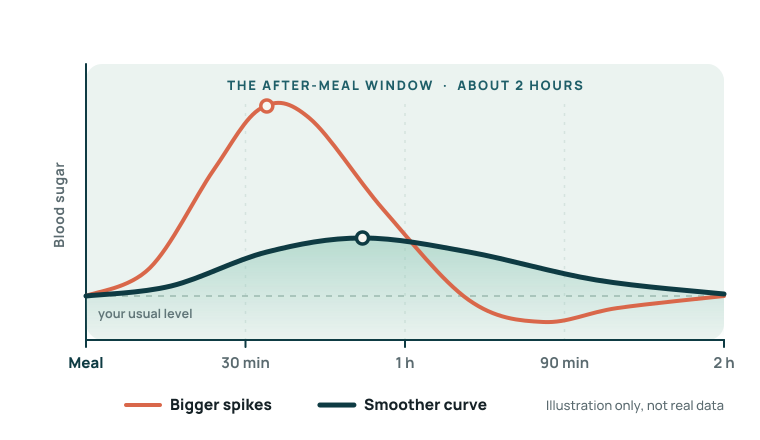
Meet the After-Meal Window
The roughly two hours after you eat, when blood sugar rises and falls again. It happens three or more times a day, every day — and how steep that curve gets is something you can shape.
1 · It starts with the lining of your blood vessels
Every blood vessel is lined with a thin layer of cells called the endothelium. It releases nitric oxide, which helps vessels relax and widen so more blood can flow. An erection depends on exactly that.
2 · Blood sugar and that lining are connected
Research links diabetes, prediabetes, insulin resistance, high blood pressure and extra belly (visceral) fat with ED. Researchers think stress on the vessel lining is part of the shared pathway — and large, repeated after-meal spikes are associated with that kind of stress.
3 · The curve is the part you can work on
You can't control your genes or your age. But studies show that everyday choices — how you build a plate, what you eat first, a short walk after eating, how well you sleep — can make the after-meal rise gentler. That's the whole idea behind EvenKeel.
Plate · Pace · Pause
Three habits, one for each part of the day. Small enough to start this week, sensible enough to keep for years.

Plate
Build meals that rise more gently.
- Half the plate non-starchy vegetables, a palm of protein, a fist of smart carbs
- Fiber and protein first, starchy carbs last — small studies show food order can lower the after-meal rise
- Easy swaps for sugary drinks and a breakfast built around protein

Pace
Use your muscles while the curve is rising.
- A 10-minute easy walk after meals — studies show short walks after eating can lower the rise in blood sugar
- 2–5 minute "movement snacks": squats, calf raises, a flight of stairs
- A gradual build toward ~150 minutes a week and two strength days

Pause
Give your body a calmer evening and night.
- Sleep basics for 7–9 hours — short sleep is linked with worse blood sugar
- A "kitchen-closed" evening wind-down (a routine, not a fasting protocol)
- A 4-minute breathing reset and a sensible look at alcohol
The 21-Day Even-Keel Plan, chapter by chapter
A clear, print-ready PDF guide written in plain English. Here's exactly what you'll read and do.
- Welcome & how to use the plan21 days, about 15–20 minutes of effort a day, and a "Before you start" safety page you'll read first.
- How erections work, in plain EnglishBlood flow, nerves, hormones and mind — and why the vessel lining matters most (with a simple diagram).
- The metabolic linkBlood sugar, insulin resistance, belly fat and blood pressure, and what they have to do with your vessels. Why ED can be an early warning sign, and the red flags that mean "see a doctor soon".
- The After-Meal WindowThe spike-vs-smooth curve explained, and how Plate · Pace · Pause fits together.
- PlateThe plate rule, food order, sugary-drink swaps, a protein breakfast, 10 example plates and a one-page shopping basics list.
- PaceThe 10-minute after-meal walk, three movement snacks you can do in work clothes, and sensible weekly targets.
- PauseSleep basics, the kitchen-closed evening, a 4-minute breathing wind-down, and alcohol without the lecture.
- The 21-day planThree weeks of daily checklists: Week 1 Plate, Week 2 adds Pace, Week 3 adds Pause. One habit layer at a time.
- Tracking that stays saneA weekly self-check for energy, sleep, walks, mood, confidence — and waist inches only if you want to.
- Working with your doctorThe tests to ask about (A1C, fasting glucose, lipids, blood pressure), questions to bring, and the treatment options that exist for ED.
- ReferencesOrganizations and research areas behind the guide: AUA, NIH/NIDDK, CDC, ADA, AHA and peer-reviewed reviews.
The Fast-Start Bonuses
Three short, printable tools in one PDF — made to sit on the fridge, in your wallet or in your doctor's folder.
The After-Meal Walk Card
A pocket-size card with three 10-minute walk routes (outdoors, indoors, at the office) and a simple tick-box week.

The Spike-Smart Grocery Swap List
Ordinary US supermarket swaps, aisle by aisle — cereal, bread, drinks, snacks, sauces — with no special products to hunt down.

The Lab Numbers Prep Sheet
A one-page sheet to bring to your checkup: which numbers to ask about, space to write them down, and the questions worth asking.
Practical pages, not pep talks
Every chapter ends with something you can actually do tonight: a checklist, a table, an example plate or a few words to say to your doctor.
- Short chapters you can read in one sitting
- Tick-box daily checklists for all 21 days
- Tip, note and safety boxes so the important parts stand out
- Prints cleanly on US Letter — or read it on your phone
Eat in order: fiber, protein, then the starch
Same dinner, different order. Start with the salad or vegetables, move to the chicken or beans, and finish with the rice or bread. Small studies show this "food order" can lower the after-meal rise.
| Day | Plate rule | Veg first | 10-min walk |
|---|---|---|---|
| Mon | |||
| Tue | |||
| Wed |
What an Even-Keel day actually looks like
No meal prep marathon, no 5 a.m. workouts. Four small moments, fitted around the day you already have.
-
Morning
A breakfast plate with protein
Eggs and a slice of whole-grain toast, or Greek yogurt with berries and nuts — instead of the sweet cereal and juice that tend to make the curve jump.
-
After lunch
The 10-minute walk
An easy loop around the block or the building while the after-meal rise is underway. Conversation pace. That's the whole workout.
-
 Mid-afternoon
A movement snack
Two to five minutes: ten chair squats, twenty calf raises, a flight of stairs. Done in work clothes, no sweat required.
-
Evening
Kitchen closed, lights down
A set time when the kitchen "closes", a 4-minute breathing wind-down and a screen-dimming routine that makes 7–9 hours of sleep more likely.
Who this guide is for — and who it isn't
A good fit if you…
- Want to understand how blood sugar, belly fat and blood-vessel health connect with erectile health
- Prefer ordinary food and walking over gyms, gadgets and special products
- Have a busy week and need habits that fit in 15–20 minutes a day
- Want to show up to your next checkup with better questions
- Like calm, adult, plain-English information with no hype
Not the right fit if you…
- Are looking for a replacement for medical care or for medicine your doctor prescribed
- Want an overnight answer, a supplement or a promise about results
- Have type 1 diabetes or an eating disorder and aren't working with your care team
- Have chest pain, fainting or other urgent symptoms — please get medical help first
Taking medicine for diabetes? Changing your food and activity can lower your blood sugar — especially with insulin or sulfonylureas — and that can cause low blood sugar. Talk with your doctor before you change your routine, and never change a dose on your own. If you have kidney disease, check protein targets with your doctor.
The 21-Day Even-Keel Plan + Fast-Start Bonuses
- The 21-Day Even-Keel Plan (PDF guide)
- Bonus 1 · The After-Meal Walk Card
- Bonus 2 · The Spike-Smart Grocery Swap List
- Bonus 3 · The Lab Numbers Prep Sheet
- Unlimited access to download and re-download
One-time payment · no subscription · digital download, nothing shipped
Get instant access — $19.90 →Secure checkout by Digistore24Shows as Digistore24 / DS24 on your statement
60 days to decide, refund through Digistore24
Read the guide, try the plan, see whether it suits the way you live. If it isn't for you, request a refund within 60 days of purchase through Digistore24 with a simple request. Details are in our refund policy.
Frequently asked questions
How will the purchase appear on my card statement?
Your order is processed by Digistore24, our authorized retailer, so the charge appears as Digistore24 or DS24 — not with the product name. Your receipt also comes from Digistore24.
Is anything shipped to my home?
No. Everything is digital: PDF guides you can read on your phone, tablet or computer, or print at home. Nothing arrives in the mail.
How fast do I get access?
Right after checkout. Digistore24 sends an email with your access link, and you can open and download the PDFs straight away.
Does it replace my doctor or my medication?
No. This is an educational guide that works alongside medical care. ED can be a sign of a heart, blood-vessel or blood-sugar problem, so please see a doctor for a checkup. Effective treatments for ED exist, including medicines your doctor can prescribe. Never stop or change a medicine without your doctor.
I take medicine for diabetes. Can I follow the plan?
Only together with your doctor. If you take diabetes medicine — especially insulin or sulfonylureas — changing what you eat and how much you move can cause low blood sugar. Talk with your doctor before changing your routine and never adjust a dose yourself. The guide is not for people with type 1 diabetes or an eating disorder unless their care team is involved.
Is it a diet?
Not in the usual sense. There's no fasting, no keto, no calorie counting and no foods you're never allowed to eat. It's a way of building ordinary meals — and eating them in a smarter order — so the after-meal rise is gentler.
Do I need a gym or equipment?
No. Pace is built on easy walking after meals and short movement snacks you can do at home or at work. If you have heart disease or another condition, get your doctor's OK before starting new exercise.
Is the content explicit?
No. The guide talks about erectile health the way a good health column would — plainly and respectfully. There are no explicit images, no sexual techniques and nothing you'd be uncomfortable leaving on the kitchen table.
What if it isn't for me?
You can request a refund within 60 days of purchase through Digistore24. See the refund policy for details.